 Read Outward
The art of taking the long way
Three ways to spend less fuel in space: meet a moving planet, find a quiet observing position, and let sunlight provide a steady push. An evergreen issue about the routes and structures that make those choices work.
In this edition
To reach Mars, first change the orbit you already have
A fuel-conscious transfer reshapes a spacecraft’s path around the Sun. Meeting Mars, entering orbit and landing each add another requirement.
How WMAP kept a faint sky signal in view
A sheltered observing position, passive cooling and comparisons between sky directions helped WMAP map the microwave afterglow of the early universe.
Sunlight supplies the push. Engineering makes the sail usable.
A solar sail must emerge from a small spacecraft, unfold reliably and hold a surface steady enough to turn light into propulsion. NASA’s ACS3 demonstration shows why those are separate challenges.
Already moving before liftoff
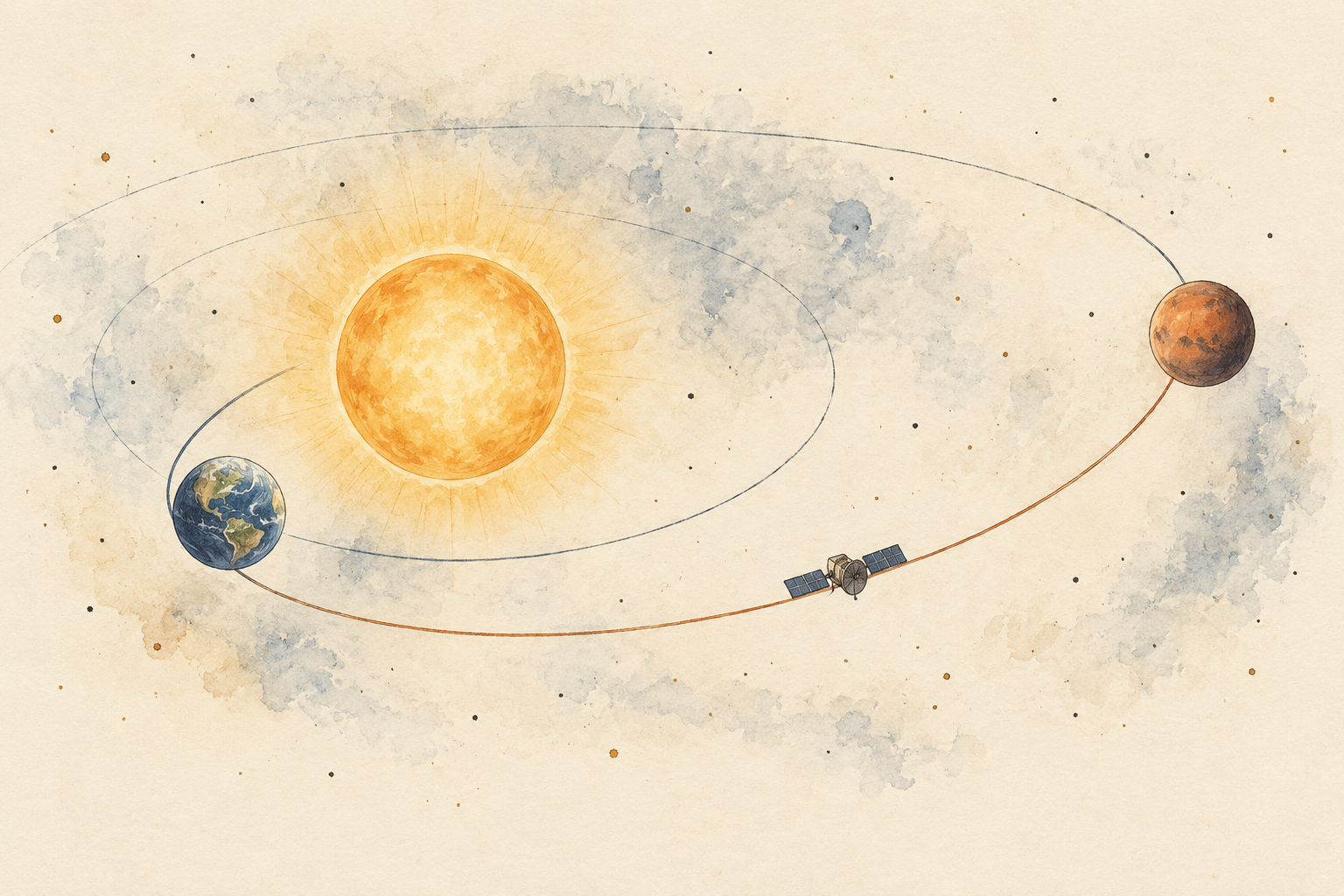
A spacecraft sitting on an Earth launch pad already travels around the Sun. Its journey to Mars begins with that existing motion: departure changes the solar orbit it already has. Here, “solar orbit” means its path around the Sun, distinct from the orbit around Mars it might enter later. The route matters because it largely …
Reading excerpt · Full article for members