Before blue was a colour, it was a journey.
A blue robe can hold a mineral’s history, a painter’s technique and evidence too small to see from the gallery floor. Start with Raphael’s Ansidei Madonna.
English sources · English reading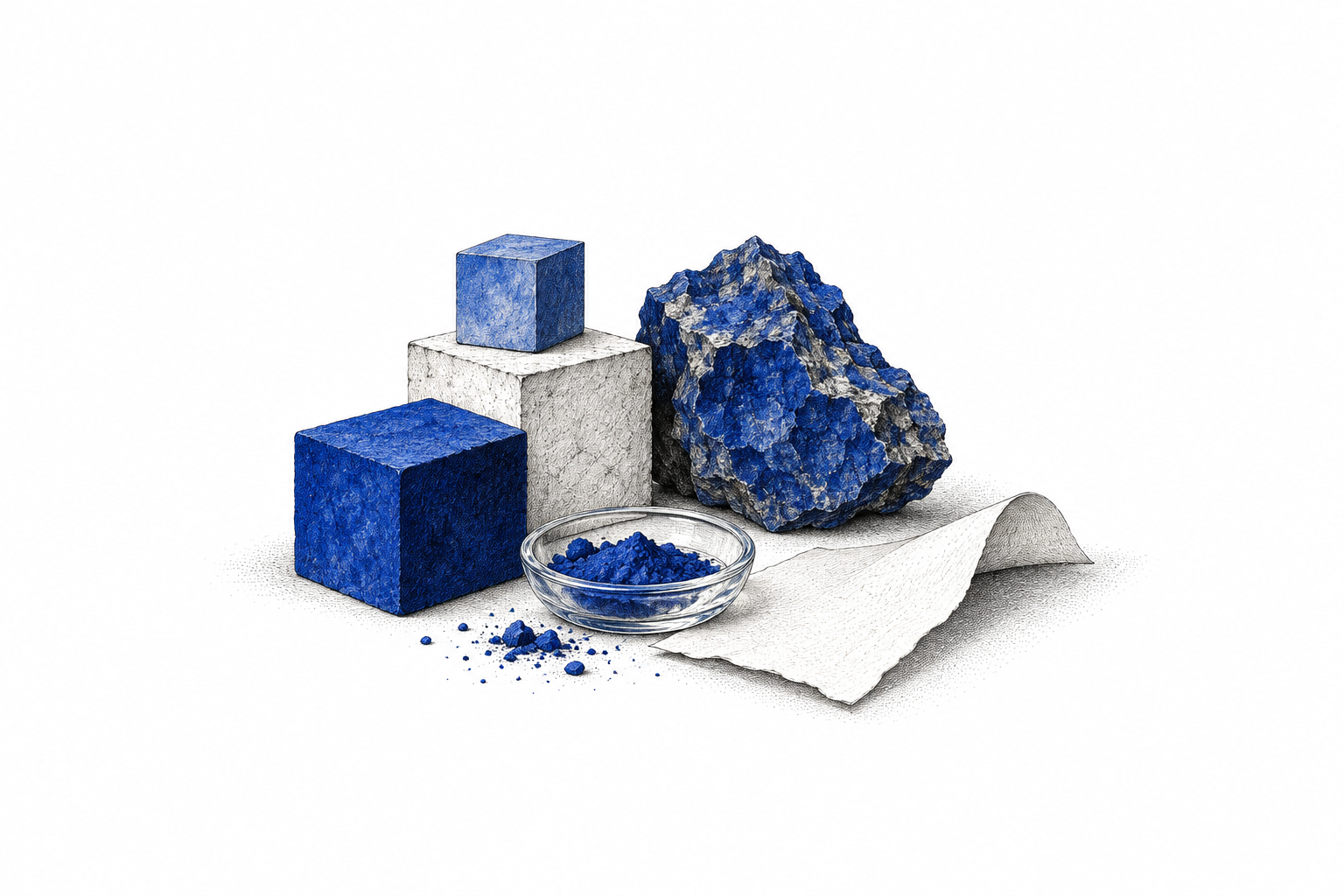
A stone is not yet a paint
Natural ultramarine began with lapis lazuli, historically mined in Badakhshan, Afghanistan. The rock contains the blue mineral lazurite alongside other minerals, including white calcite and gold-coloured pyrite. Turning it into paint therefore meant obtaining and preparing a material, then combining pigment with a binder. The National Gallery’s colour history places natural ultramarine among the especially expensive blues available to painters. That expense belongs to the material’s story, but it cannot tell us everything about a particular patch of paint. A useful starting question is smaller and more answerable: which blue substance is actually present here, and how did the painter use it?
Raphael’s blue has a structure
In Raphael’s Ansidei Madonna, dated 1505, the final layer of the Madonna’s blue drapery is a glaze of natural ultramarine. Analysis also identified walnut oil as the painting’s binder. Those details describe a made object, not simply a hue. A glaze is a transparent or translucent paint film: it alters the colour beneath while allowing that underlying colour to remain visible. Its thickness can affect the tonal result. Imagine looking through a coloured sheet rather than replacing the surface below it with an opaque sheet. The comparison makes one practical point: what you see depends on the relationship between layers, as well as on the pigment in the top one.
How can anyone know?
The museum’s material claims come from examining the painting, including minute samples taken at existing losses or damaged areas. A sample can be mounted in resin, ground and polished to expose a cross-section. Under a microscope, the arrangement becomes readable as a sequence of layers. The method changes the kind of question that can be answered. Looking at the finished surface tells us about appearance; examining the section helps establish what lies above what. One small sample is a local piece of evidence, so it is worth reading the researchers’ description rather than treating a coloured diagram as a map of the entire painting. The attraction is the connection between an assertion and a visible test.
Blue is a family of materials
The National Gallery’s Making Colour exhibition placed natural ultramarine alongside azurite, Prussian blue and the artificial ultramarine developed in the nineteenth century. Similar-looking blues can therefore begin with different substances and different ways of making them. They are not just interchangeable names for a position on a modern colour picker. This gives you a practical gallery habit: put “What is it made of?” beside “What does it mean?” The first question does not cancel the second. It makes the interpretation more specific. A blue robe belongs to a composition and a subject, but it is also paint laid down by someone using materials available in that place and period.
A painted colour is a material, a technique and a history of choices.
Journey through colour
See blue as a changing palette of substances, rather than one timeless colour.
Read at source01Studying Raphael: pigments and medium
The central case study connects Raphael’s blue robe with laboratory evidence about its materials.
Read at source02Glaze
A short definition that makes the painting’s “final glaze” an understandable technique.
Read at source03Cross-section
Learn what the tiny layered samples can reveal before reading the conservation study.
Read at source04Cross-curricular ideas: Art, trade, development
Look inside the raw stone: its blue component is only part of the material.
Read at source05