
The Fireflies Are Waiting for an Answer
Synchronous flashing looks like a light show. It is closer to a conversation: males signal from the air, females answer from the ground. Once you see it that way, the lights and footsteps of the people watching start to matter.
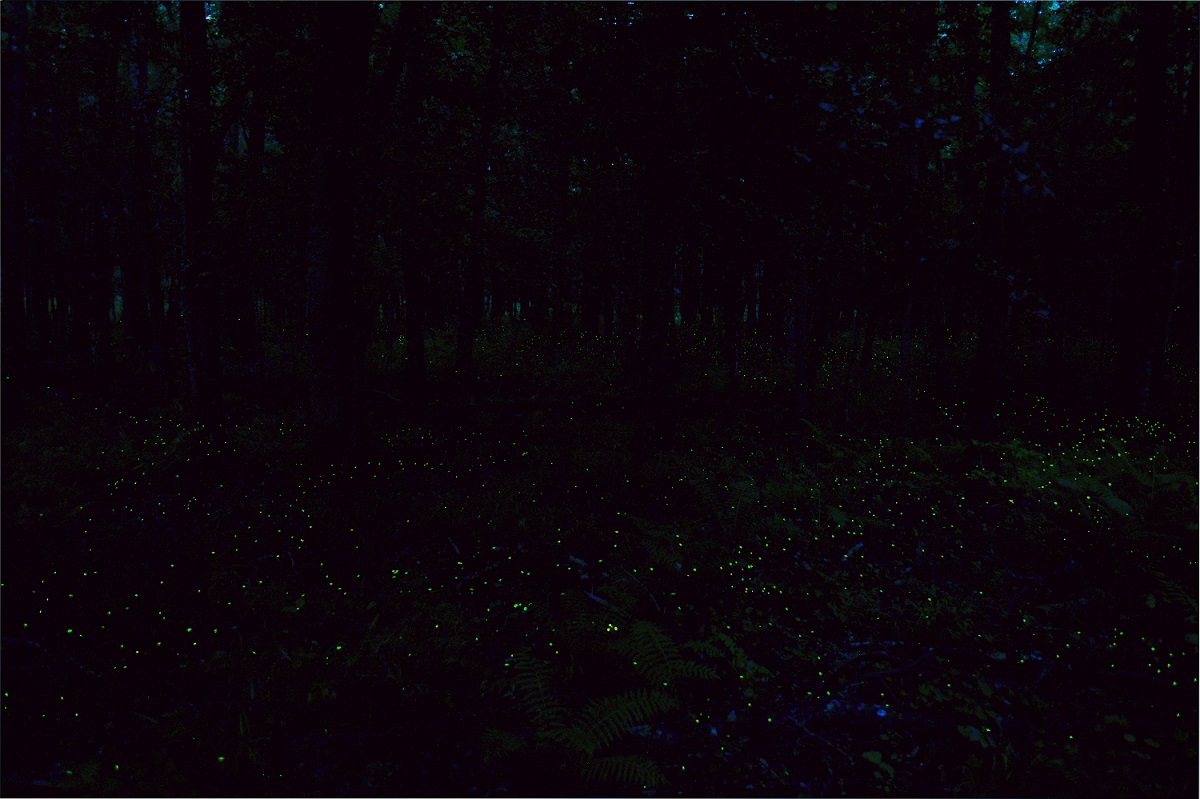
English sources · English readingThe light you notice first at a firefly display is mostly male. According to the National Park Service, the brightest, most conspicuous flashes usually come from males in flight. Females wait on the forest floor, and their signal is paler and dimmer. When a female settles on a male she likes, she points her lantern at him and flashes back. Everything happening in the air is a question waiting for that reply.
Fireflies are not flies but beetles, in the family Lampyridae, with more than 2,000 species worldwide and about 170 in North America. Adults live three or four weeks, and in the Park Service's blunt phrasing, their only goal is to find a mate.
The light itself is chemistry. In the lantern, a light-producing part of the abdomen, a compound called luciferin reacts with oxygen, helped along by the enzyme luciferase, magnesium and ATP, the cell's energy molecule, producing light with very little heat. But chemistry explains only how a firefly glows, not when or in what pattern. Some species glow steadily, some blink, and some make no light at all: of the 19 species recorded in Great Smoky Mountains National Park, six are active by day and don't flash.
How that light is switched on and off is another question. In 2001, researchers reported in Science that nitric oxide triggered light production when oxygen was present, and that removing it blocked the glow set off by a nerve chemical. The results suggested that nitric oxide synthesis may be a key factor in flash control. In that account, the bulb is chemical; the switch is wired to the nerves.
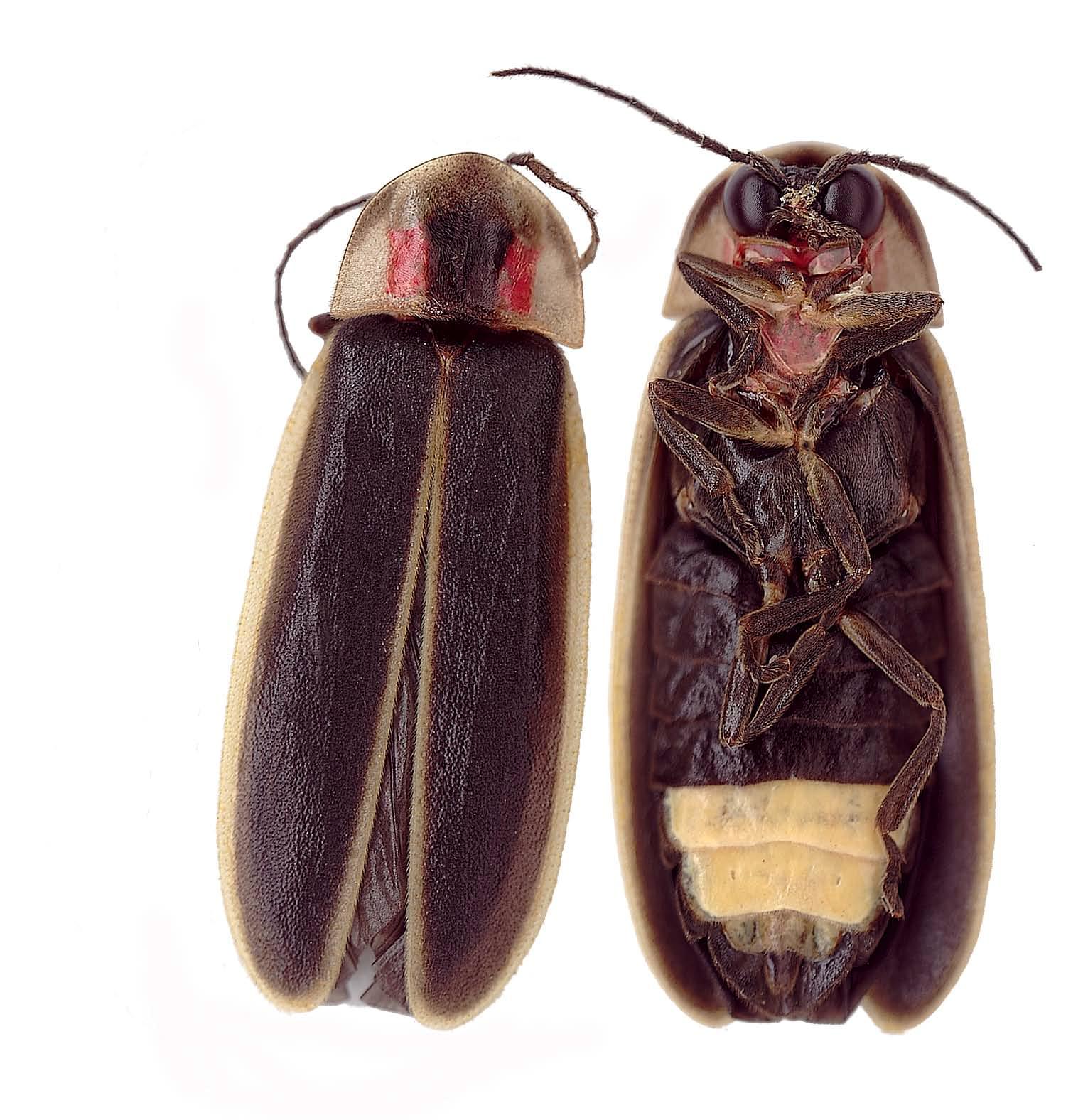
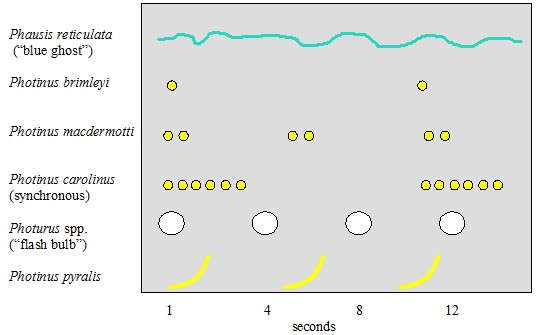
Control is what turns light into a code. Each species has its own flash length, count and spacing, which tell others of its kind who is calling. Misreading it can be fatal: in the Smokies, some Photuris fireflies mimic Photinus females' replies to lure in males and eat them.
Most males flash on their own schedules. The Park Service counts just three North American species capable of complete synchrony, and the two famous ones, in the Smokies and at Congaree, keep very different time.
Photinus carolinus, the Smokies species, fires a burst of quick flashes and then goes dark. How many flashes, and how long the dark lasts, depends on which NPS page you read: five to eight flashes and an eight-second pause on the Smokies' firefly page; five to eight flashes and eight to ten seconds of darkness on its flash-pattern page; four to eleven flashes and a six-to-nine-second pause on Congaree's page. Field counts vary, and tempo shifts with temperature. What holds steady is the shape: a burst, then silence.
That rhythm doesn't seem to live inside any one insect. In a 2023 study in eLife, researchers put a single P. carolinus in a tent screened off from the swarm. It kept flashing, but the gaps between bursts ran from a few seconds to many minutes, with no regular period. Only when about 15 fireflies shared the tent did a collective beat of roughly 12 seconds emerge, close to the wild swarm's. The proposed mechanism: each firefly flashes at random, but when it sees another flash, it joins in, so whoever goes first starts the next round. The tempo belongs to the crowd.
Why synchronize? One explanation has experimental support, though the full answer remains unsettled. In 2010, two researchers placed P. carolinus females in a virtual environment of LED "males." When the fake males flashed in sync, females responded to an average of 82 percent of flashes; when the timing was scrambled, responses fell as low as 3 percent. Their reading: a forest of males flashing out of step is visual clutter, and synchrony makes the species' signal legible. The Smokies page adds that once there is enough light in the forest, the much dimmer females answer during the males' pauses. On that account, the dark stretch is less a rest than an opening. The Park Service still calls the behavior "not yet fully understood."
Congaree's Photuris frontalis works differently. Its males cruise lower, about two to four feet off the ground, firing single, snappy flashes. The Congaree page gives one every 0.65 seconds; an NPS research summary says 0.6 to 1.0 seconds, depending on temperature; a team that filmed there in 2021 measured about 0.65 seconds, with the period ranging from half a second to a second as temperatures change. Up close, the synchrony is intermittent: a male flashes in step for several cycles, pauses, then rejoins. The 2021 recordings also captured small groups keeping the same period but flashing at a steady delay from one another. Whether synchrony helps Congaree's females pick out their males has not been tested. The park's research summary said female courtship in this species had never been observed or recorded.
With one party hidden in the leaf litter, the audience becomes part of the conversation. Great Smoky Mountains warns that flashlights can disrupt the display, and asks visitors to cover them with red cellophane, use them only while walking, aim them at the ground and switch them off at the viewing spot. It also asks people to stay on trails: females live on the forest floor, and wandering off-trail can crush them. At Congaree, an estimated 25,000 to 30,000 people came between 2017 and 2019. In 2020, the pandemic gave staff a chance to compare the viewing area with nearby woods that had seen few visitors. Synchronous activity in the viewing area, they found, had visibly decreased.
The 2021 study recorded something subtler. Early in the evening, a sparse swarm flashed largely out of step; later, an equally sparse swarm could be tightly synchronized. The researchers suggested leftover daylight might hinder how well the fireflies see one another. If dusk can blur the conversation, a white beam swept across the trees is more than bad manners.
Images: NPS. No claim to original U.S. Government works.
 National Park ServiceEnglish source
Synchronous Fireflies at Congaree
Read at source01National Park ServiceEnglish sourceFireflies
Read at source02National Park ServiceEnglish sourceFirefly Flash Patterns
Read at source03National Park ServiceEnglish source