"You Did!": The 1994 Banner That Had to Explain Clicking
In October 1994, a black strip at the top of HotWired asked readers whether they had ever clicked their mouse "right HERE." It was built in about a week for screens that might not show color, and it led not to a product but to a map of online museums. The people who made it remember why it looked the way it did, though not always the same numbers.
English sources · English readingThe page began with two words: "You did!"
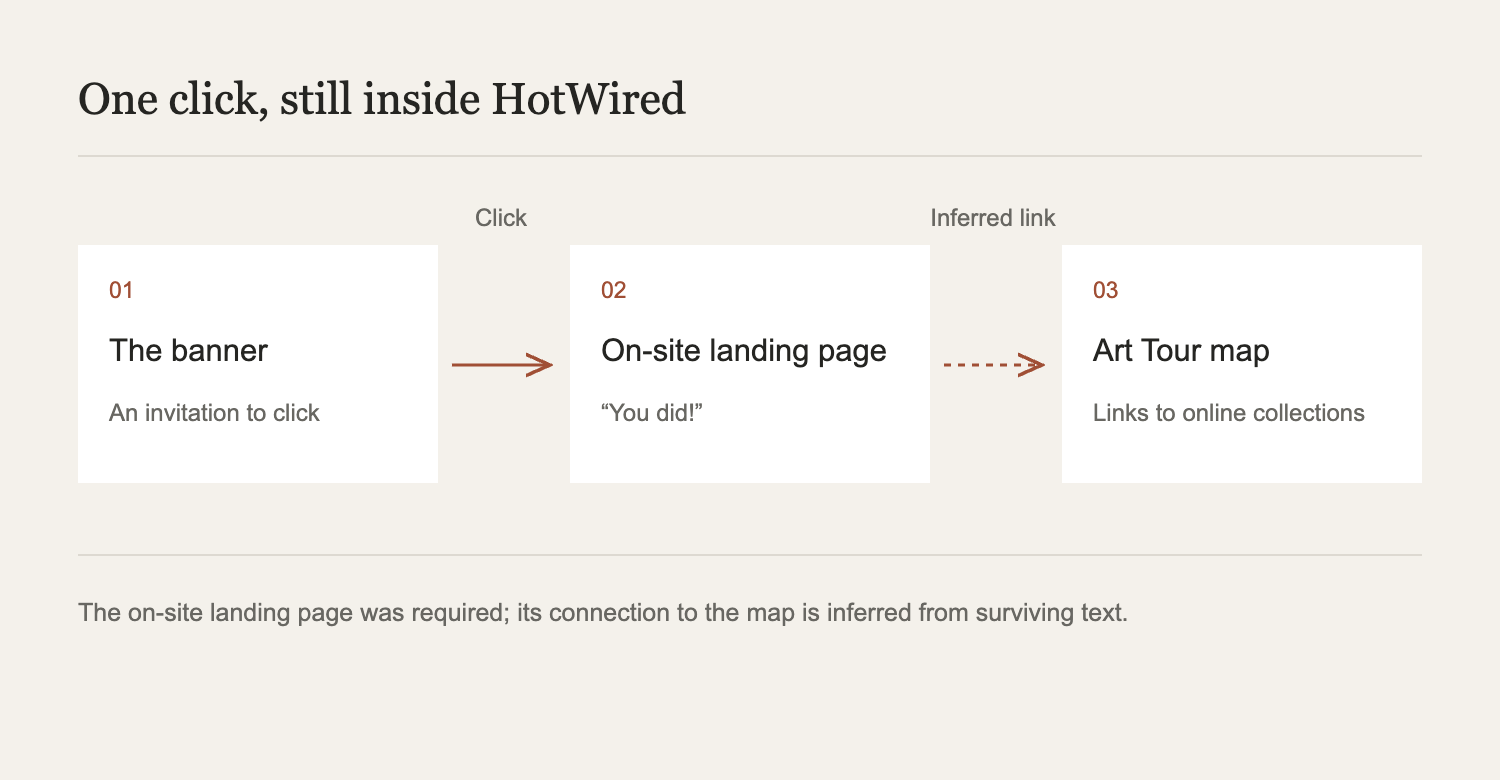
That was the answer to a question. On October 27, 1994, the day HotWired, Wired magazine's new website, went live, a strip across the top of one section asked: "Have you ever clicked your mouse right HERE?" An arrow pointed to two white words, "YOU WILL." If you clicked, you had, and the next page told you so.
View the surviving banner in the participants’ oral history
The surviving GIF is "almost the exact size, almost the exact resolution," according to the Internet History Podcast, which published it with an oral history of the first banners. Calling it the first banner ad is a convenience. HotWired launched with a dozen or so at once. "Depending upon how you count," said Craig Kanarick, who designed this one, "there were six, or eight, or fourteen." The oral history concedes that the AT&T ad wears the title partly because "it makes for a better story."
The copy borrowed a formula viewers already knew. For two years, AT&T had run TV spots built on futuristic questions ("Have you ever tucked your baby in? From a phone booth?"), each answered with "You will." Joe McCambley, the Modem Media creative who wrote the banner, recalled in a 2013 Guardian column that the client wanted a "you will" experience that would "come true immediately." So the banner asked about the one futuristic thing a reader could do on the spot.
Nor was the question rhetorical. McCambley said the little research they did found people "clicking all over the page to figure out what was clickable." Otto Timmons, a vice president at Tangent, the design firm that produced the ad, put it more bluntly: "People didn't know that it was an ad."
The work was rushed. Timmons recalled that Modem Media called eight days before launch: "It's due in 7 days!" Andrew Anker, then Wired's chief technology officer, said most monitors were 13 inches, around 640 by 480, and "color was not something you could assume," so HotWired planned its first page in thirds: the ad, the section masthead, the start of the story. McCambley remembers arguing for an hour or so over whether to use color at all.
Then, by McCambley's account (no one else in the oral history tells it), a thunderstorm cut Tangent's power around 10 p.m. the night before the files were due. Kanarick, four days in and nothing saved, rebuilt everything in a few hours. "We didn't have time to rebuild the banner in the way we originally conceived it," McCambley said. "That's why we landed upon something very simple." The team "broke some" billboard rules, like keeping copy to seven words. The question alone runs eight.
The missing logo was no accident. Kanarick said AT&T was "uncomfortable" and not "fully convinced that this was such a great idea." Timmons compared the goal to corporate sponsorship of a PBS show, since people online were "used to not being confronted with commercialism."
Clicking took you deeper into HotWired, not to AT&T. To keep the experience from breaking, Anker said, ads had to link to HotWired's own pages; an advertiser got the banner plus three pages, which could link out. Some sponsors had nowhere else to send people. "We don't have a website," recalled Bill Clausen, an AT&T advertising and communications manager.
In the landing-page screenshot preserved with the oral history, the logo finally appears. After "You did! Now let's see what else you'll do," the page apologizes to "those of you unfortunate souls who don't yet have fiber to the home" and promises small files. Three questions follow, each tagged with a tiny YOU WILL: Have you ever toured an art museum without leaving your seat? Have you ever wanted to learn more about the latest in technology from AT&T? And: "Please help us improve this space," a survey Kanarick said AT&T requested at the last minute.
The museum link apparently led to the other surviving page: an "Art Tour" world map in glowing dotted outlines, its dozen or so labeled dots including the Musée d'Orsay, the Andy Warhol Museum, the Library of Congress and collections in Jerusalem, Singapore and Australia. AT&T was sponsoring Retina, HotWired's culture section.
Timmons remembered being surprised that the Louvre "had a couple of websites already." But a museum's name need not mean its own official site. The contemporary WebMuseum was a case in point: its creator, Nicolas Pioch, wrote on the project's about page that it was neither an official nor a supported project, had no grant, and had taken over his nights and weekends. Kanarick, twenty years on, recalled "maybe five or six dots"; the surviving map has far more.
For HotWired, ads were the business plan. Founder Louis Rossetto wanted revenue from day one, and this was "before SSL," Anker noted, with "no other way to make money but getting advertisers to pay." The model: one advertiser per section, no ad server, the same ad on every reload. Anker recalled $10,000 as "a round number that made the numbers work"; Rick Boyce, who built its ad sales team, remembered "12 weeks, $30,000," with "no delivery guarantees or any kind of commitment about clicks."
Clicks are what everyone remembers. McCambley wrote in 2013 that "for over four months, 44% of those who saw it clicked on it." In the oral history he recalls the high 70s to low 80s percent for two or three weeks, then the 40s for two months or more ("Around 44% is what Bill told me"), then a slow decline. Clausen said 40 to 44 percent; Boyce, as high as 50; Anker, 70 to 80 percent on many early ads. These are remembered figures, not surviving measurement records: both sources lean on McCambley, nobody explains how views or clicks were counted, and, as Clausen put it, "we don't know what to measure it against." Today's click-through rates are no yardstick.
For scale, Anker said that well into 1995 a banner below 2 percent was a bad one, and HotWired would help fix it. Timmons recalled that the AT&T ad ran a little over ten months as the site's top performer. HotWired had sold space and time, not clicks. Twenty years later, clicks were what its veterans remembered most vividly, and agreed on least.