
The Room Is the Puzzle: How Portal Teaches You to See Space Again
Portal (2007) gives you a single ability: open two linked doorways on flat surfaces. Its small team used weekly playtests to turn that ability into a staircase of lessons, and, lacking the resources for human characters, handed the story to a disembodied voice. This piece draws on Valve's official screenshots and two developer post-mortems from 2008. No ending spoilers.
English sources · English readingThe first room Valve built for Portal had no puzzle in it. According to the developers' post-mortem in the January 2008 issue of Game Developer, they had "a very rough version of the first room of the game" running in their first week, and all you did was wait "for a portal to appear" and walk through it. They brought in playtesters anyway.
The idea came from school. At DigiPen Institute of Technology, seven students had built Narbacular Drop, a senior project in which players could "create two interconnected portals, a red and a blue, and place them dynamically around the level." Gabe Newell watched about fifteen minutes of their demo and offered them jobs "to make the game in full using the Source engine." Eight full-time developers spent 26 months on Portal, starting in July 2005; it shipped on October 10, 2007.
Steam's official description states the rule: players solve physical puzzles by opening portals to move objects, and themselves, through space. One blue, one orange, on two surfaces. Walk into one, step out of the other.
In an official screenshot of Test Chamber 04, a white sign announces "04." To the left, a floor-to-ceiling glass wall stands between you and a round exit door whose indicator shows an "X." A big red button sits on your side of the glass. You can see the way out; you can't walk to it.
In most first-person games, that is a cue to find a key, take a detour or break the glass. An official screenshot shows what Portal offers instead: a two-level room, a blue portal low on one wall, an orange one on a ledge above, a sheer wall between the floors. By the game's rule, stepping into the blue puts you on the ledge. The wall hasn't moved. It just no longer blocks anything.
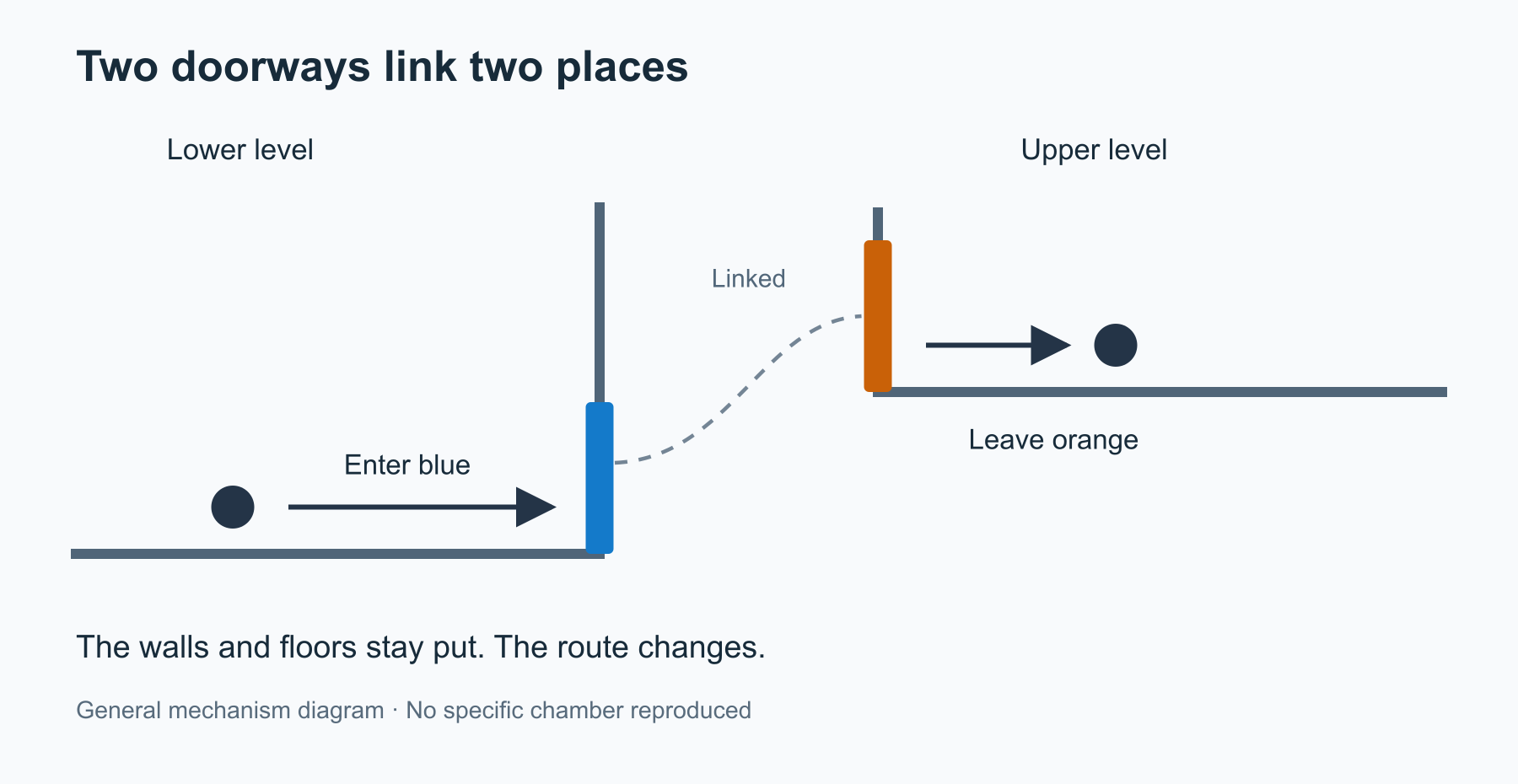
To build this, the developers had to tell Source's physics system "to make a temporary hole on only one side of a wall," with "everything behind the portal" connected "to geometry in another part of the map." Distance "became a choice of three lines connecting two points, rather than just one line," and a line of sight could "pass through a single portal more than once." A cube sitting halfway through a portal had to be touchable from both sides; an object could even "collide with itself." For the player, a room now holds more routes than its walls suggest.
With one ability, the hard part is teaching it. On Narbacular Drop, the team hadn't playtested until the last month, too late to fix most problems. At Valve, every week or whenever they built a significant new piece, they brought in someone who had never played, told them to play "just as they would at home," and watched from beginning to end. Watching shows you, they wrote, "when a player is having fun, is confused, happy, sad—everything."
One example: a section where you redirect an energy ball through a portal twice, guiding it into a socket that activates a sliding platform. As the player's first encounter with redirecting energy balls, it left several testers stuck "for a very long time." So the team added two earlier sections requiring only one redirection each. With the three in sequence, players reaching the last "managed to grasp the concept much quicker." The rule: if more than one tester struggled in an area, break its concepts into separate sections, each asking for one new thing.
Playtests surfaced a second problem: fifteen to thirty minutes in, the game "started to get a little dry." The team brought in Valve writer Erik Wolpaw, with a hard constraint: no time or staff for human characters and the animation they would need. A week later, Wolpaw returned with sample announcements for the first room's "relaxation vault," recorded on a text-to-speech program. The team liked the "funny, sinister tone," and he kept writing. The announcements gave testers "the incentive to keep playing," and in "the sterile, empty test chamber environment," players grew "attached to the alternately soothing and menacing computer guide." The voice became GLaDOS.
As the developers put it: "In effect, the environment is your enemy. GLaDOS's disembodied omnipresence gives that enemy a voice and personality." The rooms you are fighting are also talking to you.
At the 2008 Game Developers Conference, Kim Swift, the game's level designer and team lead, and Wolpaw laid out the method. A game has two stories, the written "story" story and the "gameplay story" the player lives through; "lowering the delta" between them makes the story more satisfying, and the first "must never intrude" on the second. Exposition goes into the environment where possible, such as scribblings left on walls: "quick, easy, and effective."
Their most concrete example: a "Box Marathon" level, where you carry a box a long way and put it on a button. Take one, with moving lifts over a goo pit, failed: players kept destroying the box and having to go back, "frustrating and annoying." Take two removed the lifts and the goo, added moments where the box was necessary, and made sure players could "always see the button." It still "needed something else." Wolpaw's order of operations: "Try to hint using the environment. When all else fails great dialogue is an excellent hint." It worked. This was the team's Weighted Companion Cube example.
The developers called Portal risky: "the game is short; it features a new gameplay concept, and it's a puzzle-based game with a story." Their talk also mentions players who liked "the slower-paced, cerebral nature of Portal." On that evidence, it suits people willing to stand in a room and ask whether a wall really counts, rather than racing on reflexes. Back in Chamber 04, the exit never moves. What changes is how many ways into it you can see.
Sources: Valve’s Steam description and screenshots; the developer-authored post-mortem, first published in January 2008 and reprinted online; Valve’s GDC 2008 slides.