
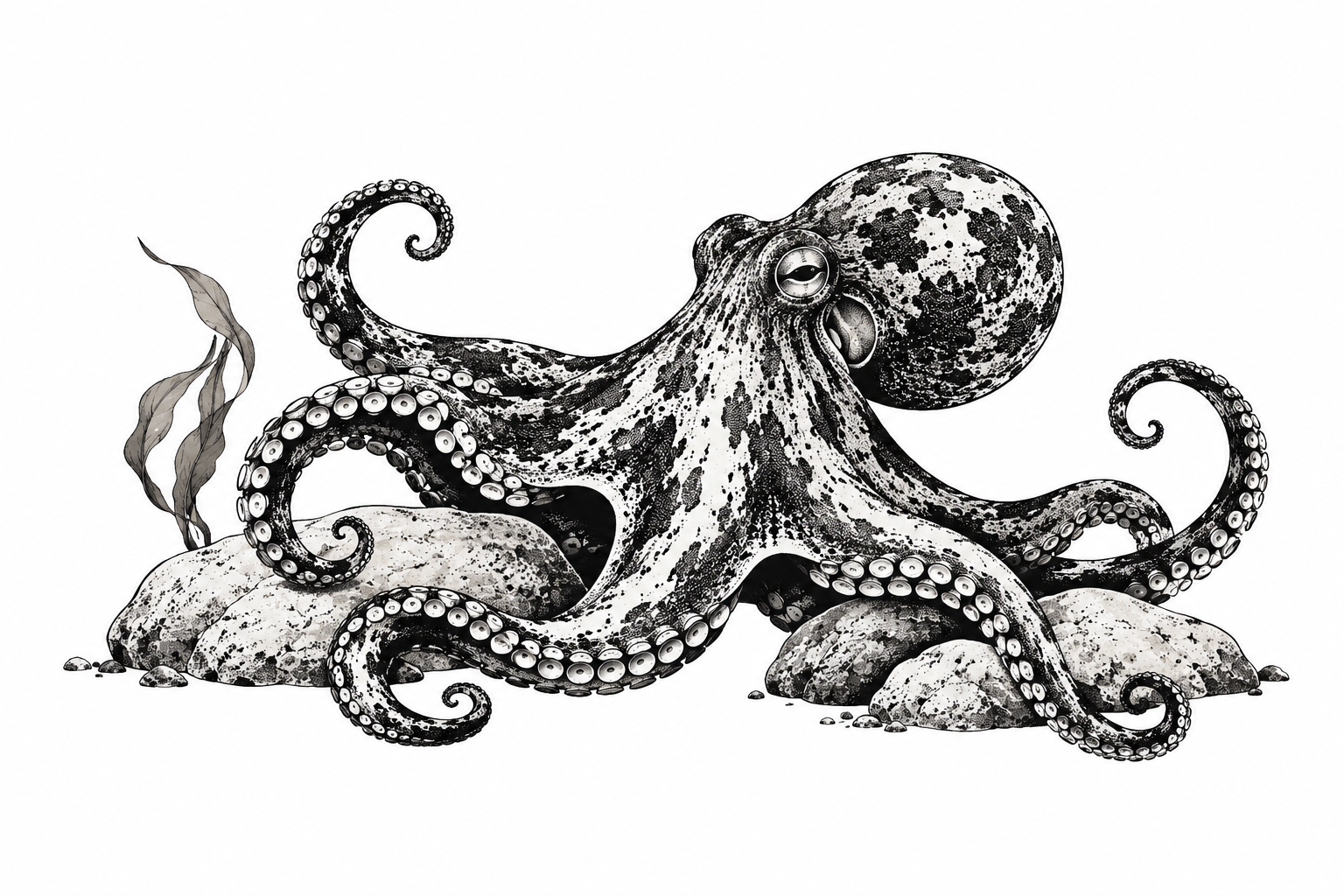
A reef is more than a colour
Imagine trying to hide a smooth brown balloon among stones. Getting its average colour right would help, but its clean outline and uniform surface would still give it away. An octopus faces that more demanding problem. It can change colour, pattern and skin texture, while posture changes the shape presented to an observer. The Hanlon Lab at the Marine Biological Laboratory studies camouflage as a sequence: sense the surroundings, select useful information, then produce an appropriate appearance and behaviour. That framing turns a spectacular transformation into a set of questions. Which marks matter against this background? Where does the animal’s edge remain visible? What happens when it moves?
Pigment changes its footprint
The coloured dots have physical machinery. Each chromatophore organ contains an elastic pigment sac, with nerves and muscles controlling its expansion. Spread the sac and a larger patch of colour becomes visible; let it contract and the patch shrinks. A rapid change can therefore come from rearranging how much existing pigment is exposed. Picture opening and closing thousands of small coloured umbrellas across a surface. The analogy describes changing coverage, not literal objects in the skin. It also explains why “turning brown” is an incomplete account: the size and arrangement of the visible patches can change the pattern as well as the overall impression of colour.
Some colour comes from light
Pigment is only part of cephalopod skin optics. Some cephalopods also have iridophores, whose layered reflecting structures produce iridescent effects, and leucophores, which reflect incoming light. These are different mechanisms from exposing more pigment. A blue-looking or silvery surface need not be a patch of blue or silver dye. That distinction matters when reading a video: a shift in brightness, angle or illumination can alter the appearance of reflected light too. The skin is a layered optical system, with different structures contributing to the result. For a careful observer, “What changed?” has more than one possible answer—even before the animal changes the shape of its skin.
A bump has its own muscles
Octopuses and cuttlefish can raise skin projections called papillae, then flatten them again. This texture control is distinct from expanding chromatophore pigment sacs. A comparative study examined nine papilla types across six species: most had muscle arrangements that lift and shape the projection, with another set apparently drawing it back down. The variety matters; a small eye projection and a large mantle projection are not one identical mechanism scaled up. In a reef scene, raised skin changes the physical surface that light reaches, rather than merely painting a bumpy-looking pattern on a flat body. Camouflage becomes a problem in three dimensions. The animal adjusts the object an observer is trying to recognise.